Discuss the Anatomical Position and anatomical Terminology
Description & Overview
1. Before You Start
Before studying this topic, you should know:
- The basic parts of the human body, such as the head, trunk, upper limbs, and lower limbs.
- The difference between the front and back of the body.
- The meaning of left, right, above, below, and middle.
These basic ideas will help you understand how anatomical terms describe the location of body parts.
2. Topic Overview
Anatomical position is the standard reference position of the human body used in anatomy to describe the location, relationship, and orientation of body structures.
Anatomical terminology refers to the standardised set of scientific terms used to describe the location of body structures in relation to one another. These terms provide a clear and consistent method of describing the human body, reducing confusion that may arise from using everyday directional words.
Anatomical position serves as the reference point for directional terminology. These terms remain consistent regardless of the actual posture or movement of the individual.
3. Understand the Topic
Want a simpler Hindi-English explanation? Read this topic in Hinglish.
A. Anatomical Position
The human body needs a fixed reference position so that we can describe the location of body parts consistently. If everyone describes body parts according to their current posture, confusion can occur.
For example, imagine a person standing upright with their arms at their sides. Now, imagine the same person lying on their side. The arm that was previously at the side of the body may now appear to be above or below the body, depending on how the person is lying.
If we use words such as “above” and “below” to describe body parts without a standard reference, confusion can occur because their apparent positions change when the person's posture changes.
To avoid this confusion, anatomy uses a standard reference position called the anatomical position. It allows us to describe the location of body parts and their relationships consistently, whether a person is sitting, standing, or lying down.
Features of Anatomical Position
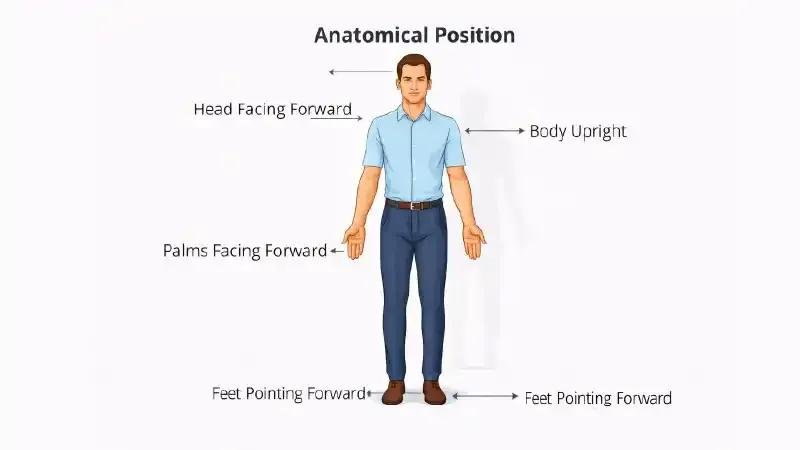
In the anatomical position, the person:
- Stands upright, facing forward.
- Keeps the head straight, with the face and eyes directed forward.
- Keeps both arms by the sides of the body.
- Keeps the elbows straight and the palms facing forward.
- Keeps the fingers straight and together, with the thumbs pointing away from the body.
- Keeps both legs straight.
- Keeps the feet flat, parallel to each other, and directed forward.
Important: In the anatomical position, the palms face forward, not towards the thighs. Because of this position, the thumbs are on the outer sides of the hands, while the little fingers are on the inner sides.
B. Why Do We Need Anatomical Position?
Imagine a physiotherapist telling another physiotherapist:
“The patient has pain above the knee.”
Where exactly is the pain? There are different possibilities:
- The pain may be in the thigh, which is superior to the knee.
- The pain may be around the patella (kneecap), which is located on the anterior aspect of the knee.
Simply saying “above the knee” may not clearly identify the exact location. Therefore, we need to learn how to describe the location of body parts accurately using anatomical terms.
How Does Anatomical Position Help Here?
Anatomical position provides a standard reference that helps us describe where body parts are located and how they relate to one another.
- Superior: Towards the head or above another body structure.
- Anterior: Towards the front of the body.
- Medial: Towards the midline of the body.
- Lateral: Away from the midline of the body.
Using these terms, a physiotherapist can describe the location of pain more clearly:
- If the pain is in the thigh, it can be described as superior to the knee.
- If the pain is around the kneecap, it can be described as being on the anterior aspect of the knee.
- If the pain is on the inner side of the knee, it can be described as being on the medial aspect of the knee.
- If the pain is on the outer side of the knee, it can be described as being on the lateral aspect of the knee.
These terms do not change when a person stands, sits, or lies down. For example, when a person lies on their side, the medial side of the knee may face upwards, but it remains the medial side.
Anatomical position does not mean that a person must always maintain the same posture. Instead, it serves as a standard reference for describing body structures accurately, regardless of whether the person is standing, sitting, or lying down.
Anatomical position and terminology help us to:
- Describe the location of body parts clearly.
- Use the same anatomical language across students and healthcare professionals.
- Reduce confusion when examining patients and describing body movements.
C. Anatomical Terminology: Directional Terms
Directional terms describe the position of one body structure in relation to another.
1. Superior and Inferior
- Superior: Towards the head or upper part of the body; above another structure.
- Inferior: Towards the feet or lower part of the body; below another structure.
In simple terms, superior refers to the direction of the head, while inferior refers to the direction of the feet.
| Example | Explanation |
|---|---|
| The head is superior to the neck. | The head is above the neck. |
| The chest is superior to the abdomen. | The chest is above the abdomen. |
| The knee is inferior to the hip. | The knee is below the hip. |
| The stomach is inferior to the heart. | The stomach is below the heart. |
Remember: Superior and inferior describe the relative positions of body structures, not merely their positions as they appear on a screen or in an image.
2. Anterior and Posterior
- Anterior: Towards the front of the body.
- Posterior: Towards the back of the body.
In simple terms, anterior describes the front side of the body, while posterior describes the back side.
| Example | Explanation |
|---|---|
| The sternum is anterior to the heart. | The sternum is in front of the heart. |
| The vertebral column is posterior to the sternum. | The vertebral column is behind the sternum. |
| The patella is anterior to the knee joint. | The patella is in front of the knee joint. |